
物联网解决方案

RFID in Cold Chain: From Raw Material to Finished Product

May 14, 2026

Cold chain logistics is one of the most demanding environments for tracking technology. Temperature fluctuations, humidity, condensation, and the need for rapid handling all create challenges that barcodes and manual systems simply cannot handle reliably.

RFID (Radio Frequency Identification) has emerged as a practical solution. Unlike barcodes, RFID tags do not require line‑of‑sight. They can be read through cardboard, plastic, and even condensation‑covered surfaces. More importantly, RFID enables real‑time, automated tracking of assets throughout the entire cold chain – from the moment raw materials arrive at a production facility to the final delivery of finished goods.

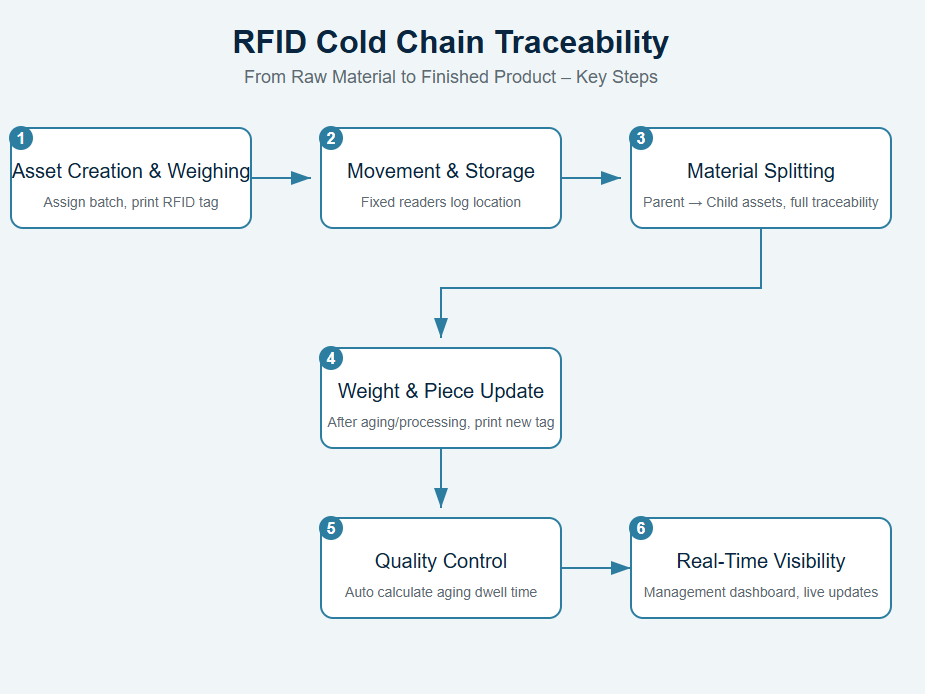
The diagram you shared illustrates exactly how a well‑designed RFID system works in food production, which is inherently a cold chain environment. Let me walk through the key stages and explain the value at each step.


1. Asset Creation & Initial Weighing

When raw materials arrive – for example, fresh meat, dairy, or frozen vegetables – they are weighed and assigned a batch number. A unique RFID tag is printed and applied to the container or pallet. That tag becomes the digital identity of that asset in the system.

From that moment on, every movement, every temperature check, and every processing step can be logged against that tag. No more paper logs or manual data entry errors.

Cold chain benefit: The tag can carry not only an ID but also sensor data (e.g., temperature at receipt). If the raw material arrived above the required temperature, the system can flag it immediately.


2. Movement & Storage

Once tagged, the asset moves through the facility – from receiving dock to cold storage, from cold storage to production line, or between different temperature zones (e.g., chiller to freezer). Fixed RFID readers installed at portals or doorways automatically record each movement. Operators can also use handheld RFID readers for manual scans.

Cold chain benefit: No need to open doors or pause operations to scan. The system knows exactly where each batch is located in real time. If a pallet sits too long in a transitional area (e.g., a loading dock), an alert can be triggered to prevent temperature abuse.


3. Material Splitting (Parent to Child Assets)

A large “parent” asset – say a cart full of raw meat – may be divided into multiple “child” assets (e.g., individual batches of sausage mixture or different cuts of meat). The RFID system allows splitting while maintaining full traceability back to the original raw material batch.

Cold chain benefit: Each child asset gets its own RFID tag, and the system records the time of split. This ensures that even after repackaging, the temperature history of the original batch is not lost.


4. Weight & Piece Update After Aging or Processing

In many cold chain processes – especially meat, cheese, or produce – weight changes occur. Meat loses moisture during aging. Cheese loses weight during ripening. After such a stage, the asset is reweighed, and the data is updated. A new RFID tag is printed and applied, replacing the old one while preserving the full history.

Cold chain benefit: The system automatically calculates weight loss percentages and can correlate them with time‑temperature exposure. This provides valuable quality data – for example, if a batch aged too quickly due to higher‑than‑allowed temperatures, the system can flag it for inspection.


5. Recipe Composition (Future Feature)

A more advanced capability (currently in analysis, as noted in your diagram) allows combining materials from multiple source batches to create a new product – for example, sausages made from meat that came from three different lots. The system will ensure that the final product is traceable back to each original ingredient batch.

Cold chain benefit: In complex cold chain manufacturing (e.g., ready‑to‑eat meals, frozen pizzas, mixed vegetable packs), ingredients arrive from different suppliers and different cold chains. RFID enables complete ingredient‑level traceability without slowing down production.


6. Quality Control & Aging Monitoring

The system automatically calculates how long each asset has stayed in a curing or aging cell. This data is not estimated – it is precise, based on actual entry and exit reads. Quality control teams can monitor in real time.

Cold chain benefit: Aging and ripening are time‑temperature dependent. With RFID, you can not only track duration but also cross‑check against temperature logs from the same tag (if using sensor‑enabled tags). This turns quality control from reactive to proactive.


7. Real‑Time Visibility for Management

Finally, the management dashboard provides a constantly updated view of production progress and batch locations. No more waiting for daily or weekly reports. If a problem arises – a stuck pallet, a missed scan, a temperature excursion – it is visible immediately.

Cold chain benefit: In cold chain, time is perishable. Real‑time visibility means faster corrective action. Less waste. Less risk.


Why RFID Over Other Technologies for Cold Chain?


Feature Barcode Manual Logs RFID
Line‑of‑sight required Yes N/A No
Read through condensation No N/A Yes
Read multiple assets at once No N/A Yes (up to hundreds)
Automated data capture No No Yes
Works in freezing temperatures Limited (label adhesion) Yes (but error‑prone) Yes (special adhesives available)
Real‑time location tracking No No Yes

Practical Advice for Cold Chain RFID Implementations

Based on real project experience (including our work with food producers, logistics operators, and冷链 warehouses), here are a few practical tips:

  1. Choose the right tag adhesive – Standard adhesives become brittle at -25°C. Use cold‑chain‑rated adhesives or mechanical attachment (e.g., cable ties on pallets).

  2. Use encapsulated tags for wet environments – For meat processing or freezer applications, consider ruggedized tags (e.g., our TA series ABS tags with IP68 rating).

  3. Position readers strategically – Install fixed readers at transitions between temperature zones (cold room entry/exit, dock doors). This captures movement without requiring operators to scan manually.

  4. Integrate with your ERP/WMS – RFID data is most valuable when it flows into your existing systems. Our readers provide standard APIs (HTTP/MQTT) for easy integration with SAP, Odoo, or custom platforms.

  5. Start with a pilot – Pick one production line or one cold storage room. Tag a few hundred assets. Measure the reduction in search time, inventory accuracy, and manual data entry errors. Then scale.


Final Thoughts

Cold chain is not forgiving. Every hour of lost visibility can mean spoiled goods, rejected shipments, or compliance failures. RFID does not solve every problem, but it solves the problem of knowing where your assets are and what has happened to them.

The system described in your diagram – with asset creation, movement tracking, splitting, weight updates, and real‑time dashboards – is not theoretical. It is running today in food production facilities across Europe and beyond.

If you are considering RFID for your cold chain operations, start by asking: What is the cost of not knowing? The answer will tell you if RFID is worth it.


SeeMore IoT manufactures UHF RFID readers, handhelds, antennas, and cold‑chain‑rated tags. For a free consultation or sample tags, contact us at info@seemoretek.com.


需要帮忙?与我们聊天

留言
如有任何信息或技术支持请求,请填写此表格。所有标有星号*的字段均为必填项。
提交
Looking for Contact
联系我们 #
+8618682338756

我们的营业时间

11月21日(周一)至11月23日(周三):上午9点至晚上8点
11 月 24 日星期四:休息 - 感恩节快乐!
周五 11/25:上午 8 点至晚上 10 点
周六 11/26 - 周日 11/27:上午 10 点 - 晚上 9 点
(所有时间均为东部时间)

首页

产品

whatsApp

接触