
搜索信息
你要买什么?
Publication Notes - delete before publishing
Item-level RFID is no longer the hard part. Integration is.
Walk any self-checkout floor in Europe, Asia, or the Americas and you will hear the same thing from the integrator who built it: the chips work, the tags work, and the rollout still stalls. It stalls at the counter — the point where a tag ID must become a line item inside point-of-sale software that was never designed to talk to an RFID reader.
The business case has been settled for a decade. Industry benchmarks routinely put barcode-based inventory accuracy near 78%. Item-level RAIN RFID pushes the same shelves past 96%. What remains is a plumbing problem, and plumbing is what we build. We build the rest of that stack too — desktop, handheld, fixed, and the labels themselves.
The Aura A022 is our answer: a multi-trigger UHF RFID desktop reader built to live on the counter and behave like the simplest device in the store — a barcode scanner.
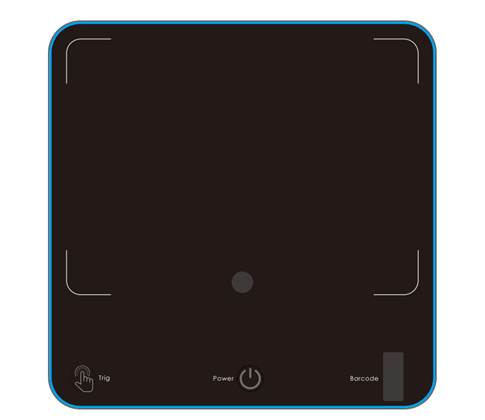
Most RFID readers were designed for dock doors and stockrooms. Put one on a checkout counter and three costs appear at once.
Host software. The reader speaks one protocol, the POS speaks another. Someone has to write and maintain that translation layer, and someone has to keep it alive through every POS upgrade.
Drivers and power. A counter device that needs a separate brick, a separate port, and a separate support ticket is a device the IT team will quietly veto.
Trigger logic. Shoppers do not follow a script. Some drop a basket and walk away. Some hold a single item up. Some wait for the cashier to do it for them.
Solve all three and self-checkout RFID ships. Solve two and the pilot never becomes a rollout.
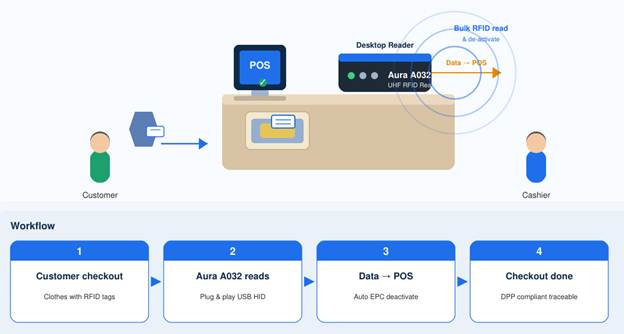
A shopper clears a basket of tagged items at a self-checkout counter in one pass, with no item-by-item barcode alignment.
We designed the A022 against four requirements. Each one is a place where deployments usually fail.
1. Read item-level RFID without asking the shopper to think. Orientation, stacking, and foil-lined packaging are the antenna's problem, not the customer's.
2. Deliver data to whatever the checkout already runs. No middleware, no host application, no SDK deployed to the till.
3. Degrade gracefully when a tag is missing. Untagged, damaged, and returned-without-tag items still have to clear the lane.
4. Match the trigger to the flow. Place-and-forget, hands-in-zone, and explicit cashier confirmation are three different stores.
Most desktop readers cover one or two. The A022 covers all four.
Trigger behaviour is where counter design succeeds or dies, so we made it a hardware decision rather than a software project.
· Long-read mode. Continuous reading for place-and-forget flows. Drop the basket, read the basket.
· TOF laser trigger. Time-of-flight detection across 0–400 mm. Reading begins the moment an item enters the zone.
· Touch trigger. A deliberate press, for cashier-driven confirmation and high-value items.
One device covers hands-free lanes, attended counters, and returns desks. The integrator configures it once, and store staff can change it without a ticket.
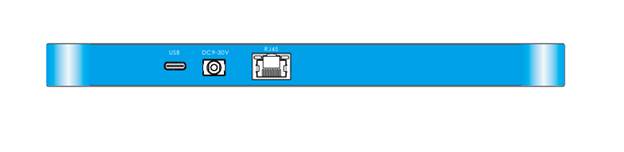
Tempered glass read surface, aluminium body, and USB Type-C / RJ45 on the edge of the Aura desktop reader.
Under the glass sits the new-generation Impinj E310 reader chip, running ISO 18000-6C / EPC C1G2 with Gen2X.
· >350 tags per second throughput
· –73 dBm receive sensitivity
· 0–1.2 m read zone
· 5–30 dBm output power, ±1 dB, adjustable in 1 dB steps
That 1 dB step matters more than it looks. Apparel, cosmetics, books, and jewelry all want different power at the counter. With the A022 you tune per deployment instead of buying a different reader per category.
Regional coverage is built into one platform: FCC 902–928 MHz, ETSI 865–868 MHz, and CMIIT 920–925 MHz. Order the regional SKU, deploy globally.
No retailer is fully tagged on day one. Returns, supplier exceptions, and legacy stock keep barcodes in the lane for years.
The optional 2D barcode engine reads PDF417, QR Code, Data Matrix, Code 128, and EAN, plus the standard 1D and 2D symbology set. One device, one cable, one API call — your application receives a clean identifier regardless of which technology produced it.
That is what keeps a mixed-estate rollout moving instead of stalling at 80% coverage.
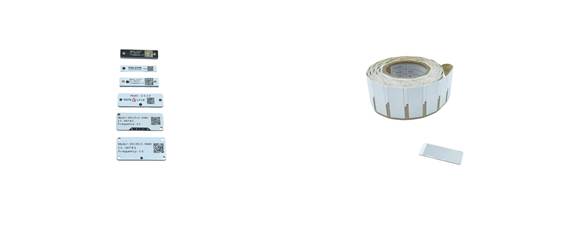
Retail UHF RFID labels — general-purpose UHF inlays and flexible on-metal tags — read together in a single A022 scan.
The A022 connects over USB Type-C: bus-powered, driver-free, and presented to the host as HID keyboard emulation. Tag IDs land at the cursor, exactly like a handheld barcode scanner.
For fixed installations there is RJ45 Ethernet, with optional PoE (IEEE 802.3af/at, 30 W) and optional Bluetooth 4.2 + SPP 3.0 for wireless POS carts and pop-up counters.
For the IT team, this is the whole point: no new agent, no new driver package, no new exception in the endpoint image.
A checkout surface is public, hostile, and short on space.
The A022 measures 218 × 218 × 18 mm and weighs about 1 kg. The read surface is tempered glass; the body is aluminium. It ships in black or blue-grey and operates from –25 °C to +70 °C, which covers unheated stockrooms, kiosks in hot climates, and everything between.
Eighteen millimetres means it drops into an existing counter cut-out beside the payment terminal, instead of forcing a furniture redesign.
An Aura desktop reader integrated into a retail self-checkout counter beside the payment terminal, with no additional power brick.
The A022 is one node in the retail platform we ship to integrators and OEM brands worldwide.
· Aura A033 — larger 320 × 320 mm desktop readers for high-volume counters.
· Vita H70 / H80 — handheld terminals (Impinj E710, >400 tags/s, 10,000 mAh) for cycle counts, click-and-collect, and stockroom verification.
· Symo FR54A — fixed multi-port readers with onboard Linux and edge compute for dock doors and back rooms.
· UHF RFID labels — general-purpose PET inlays and flexible on-metal tags tuned for retail use.
All of it runs on the same SDK, in C#, Java, C++, and Python. Integrate once, deploy the whole family. Our partners already run SeeMore hardware against Odoo, SAP, and major WMS/MES platforms.
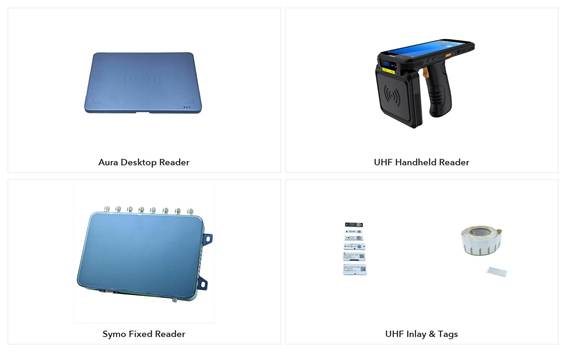
The SeeMore retail portfolio: Aura desktop readers, UHF handheld readers, Symo fixed readers, and UHF labels on one SDK.
We have spent more than fifteen years building RFID hardware for integrators, and the same three requests come back every quarter.
No vendor lock-in. Open SDK, documented protocol, no proprietary layer between the reader and your application.
Customisation in weeks. Enclosure colour, firmware features, OEM branding — typically four to six weeks, because you are talking to the factory rather than a distributor.
Direct engineering support. Your integration team speaks to the engineers who designed the reader, not to a script.
The A022 inherits the architecture we already ship in the Aura A032/A033, refined for the next generation of self-checkout flows.
The Aura A022 ships today in FCC and ETSI SKUs: A022A-C-E310-FCC and A022A-C-E310-ETSI. CMIIT variants and OEM configurations are available on request.
If you are integrating self-checkout, returns, or click-and-collect, contact our retail solutions team for an evaluation unit and the unified SDK.
SeeMore IoT · Retail & Checkout Automation · September 2026

电话 : +8618682338756
电子邮件 : info@seemoretek.com
Whatsapp : +8618682338756